📅 Event Preview
MATS 2026 · Busan
Maritime AI
Cybersecurity
Maritime AI & Tech Summit 2026
Why I'm Heading to Busan on 28 October
An innovation advisor's preview — what I expect, and what I'll be asking in every session
📍 Hyatt Place Busan Yeonsan · Oct 28, 2026

For years my work has been about moving smart-ship architecture, digital twins and autonomy off the slide deck and onto real ships and ports across the Asia-Pacific. Every one of those projects eventually hits the same wall: the ship becomes a node on a network, and the question is no longer whether AI comes aboard but how we keep it safe, accountable and compliant once it does. That is exactly the question the Maritime AI & Tech Summit 2026 (MATS2026), hosted by Rakuten Maritime in Busan, sets out to answer. Here is my preview: why I think this one is worth a day out of the office, and my take on every announced session.
📅 Date
Wed, 28 Oct 2026
09:30 – 18:00 KST
📍 Venue
Hyatt Place Busan Yeonsan
Ballroom II (7F)
🏢 Host
Rakuten Maritime
KR–EN interpretation
🎟️ Entry
Pre-registration
Invitation e-mail required
1. Why This Summit Caught My Attention
I attend a lot of maritime events. Most of them treat AI and cybersecurity as two separate tracks in two separate rooms. MATS2026 is built on the opposite premise — its own tagline is “Navigating a Safe Path to the Future of Maritime”, with cybersecurity framed as the thing that guides AI safely to its destination. That framing is exactly right, and here are the four reasons I'm looking forward to it:
⚓ Three classification societies in one room
ClassNK, ABS and RINA all on one programme is rare. Anyone who has worked an IACS UR E26/E27 project knows the rules are unified, but the interpretations are not. Hearing three societies side by side — and then in the same panel — is the fastest way to see where they converge and where they still differ.
🏭 Busan is the right city for this conversation
Korea builds a large share of the world's newbuildings, and the shipyards, equipment makers and owners who actually implement E26/E27 are a short drive from the venue. This is a summit held where the steel is cut — not a theoretical discussion.
🎓 Academia, vendors and class — the full chain
The line-up runs from university research (Plymouth) to security vendors (Fortinet, CYTUR) to class societies and a system integrator's own R&D team. That is the whole value chain from research to rule to deployment.
⏱️ Timing: E26/E27 ships are now in service
E26/E27 became mandatory for ships contracted from 1 July 2024. Those ships are now delivering, which means the industry is moving from “how do we pass the survey?” to “how do we operate and keep this secure for 25 years?” — while AI systems are being added on top. This summit lands right in that transition.
2. The Programme at a Glance
The day is split into three parts: Part 1 — Building a Resilient Maritime Future (morning), Part 2 — Navigating the AI Era: Intelligence, Security & Trust at Sea (afternoon), and Part 3 — a Panel Discussion to close. Korean–English interpretation is provided throughout.
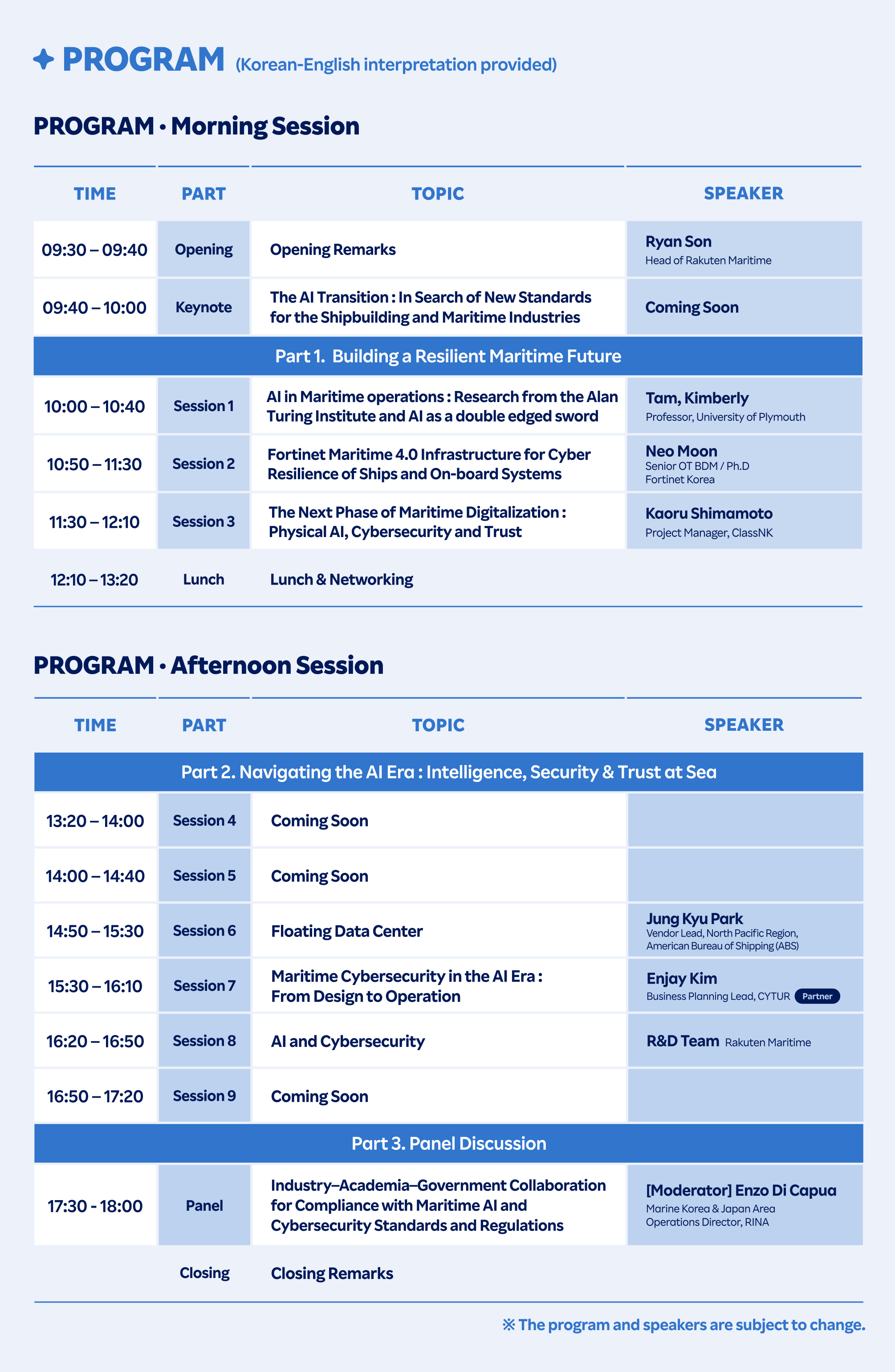
Official programme (image: Rakuten Maritime). Programme and speakers are subject to change.
3. Session by Session — My Take
For each announced session: what I expect to hear, and the one question I'll bring from smart-ship projects and class discussions. The “Iaan's Pick” rating is simply how strongly I'd tell a colleague not to miss it.
PART 1 · Building a Resilient Maritime Future — Morning
09:40 – 10:00
KEYNOTE
Iaan's Pick ★★★★☆
The AI Transition: In Search of New Standards for the Shipbuilding and Maritime Industries
Speaker to be announced · Opening remarks by Ryan Son, Head of Rakuten Maritime (09:30)
The title says “in search of” new standards — an honest admission that we don't have them yet. For cybersecurity we have E26/E27 and IEC 62443; for AI on board there is no equivalent single rulebook. I hope the keynote maps the current landscape (class AI guidance, the IMO MASS Code for autonomous ships, national rules) instead of just announcing that “AI is the future.”
❓ My question: Should AI assurance be bolted onto E26 as a new “system category,” or does it need its own unified requirement?
10:00 – 10:40
SESSION 1 · ACADEMIA
Iaan's Pick ★★★★★
AI in Maritime Operations: Research from the Alan Turing Institute and AI as a Double-Edged Sword
Tam, Kimberly · Professor, University of Plymouth
My must-see session of the morning. Plymouth has been one of the leading academic voices on maritime cyber risk, and “double-edged sword” is the right framing: the same AI that helps detect anomalies can be fooled by manipulated sensor data, and the same models that help defenders also help attackers write convincing phishing for crew. Independent research — with no product to sell — is exactly what this agenda needs at the top.
❓ My question: When an AI navigation or decision-support tool is wrong, how should the officer of the watch be trained to recognise it — and who carries the accountability?
10:50 – 11:30
SESSION 2 · CYBERSECURITY
Iaan's Pick ★★★★☆
Fortinet Maritime 4.0 Infrastructure for Cyber Resilience of Ships and On-board Systems
Neo Moon · Senior OT BDM / Ph.D, Fortinet Korea
A vendor session, and I'll judge it by one standard: does it map to the ship, not the office? E26 asks for security zones and conduits, network segregation and protection of OT systems that can't be patched on a weekly cycle. I want to see how the architecture handles limited and expensive satellite bandwidth, a crew that is not a SOC team, and equipment from dozens of different makers.
❓ My question: With LEO connectivity now on many ships, how does the reference design keep the IT/OT boundary from quietly eroding after delivery?
11:30 – 12:10
SESSION 3 · CLASS
Iaan's Pick ★★★★★
The Next Phase of Maritime Digitalization: Physical AI, Cybersecurity and Trust
Kaoru Shimamoto · Project Manager, ClassNK
“Physical AI” is the phrase I most want unpacked this year. Once AI stops recommending and starts acting — controlling machinery, steering, mooring, inspection robots — a cyber incident is no longer a data breach, it's a safety event. A class society talking about trust means talking about verification: how do you survey something that learns? Coming from smart-ship and MASS projects, this is the gap I run into most: autonomy needs a trust model that class can actually verify. ClassNK's view here could set the tone for the whole afternoon.
❓ My question: If a model is updated after delivery, is that a “management of change” event under E26 — and what evidence would class expect?
🍱 12:10 – 13:20 · Lunch & Networking — honestly, often the most valuable 70 minutes of any summit. Come with business cards.
PART 2 · Navigating the AI Era: Intelligence, Security & Trust at Sea — Afternoon
Sessions 4 & 5 (13:20 – 14:40) and Session 9 (16:50 – 17:20) are still marked “Coming Soon,” and the organiser says more speakers will be announced. I'll update this post when they are confirmed.
14:50 – 15:30
SESSION 6 · CLASS
Iaan's Pick ★★★★☆
Floating Data Center
Jung-Kyu Park · Vendor Lead, North Pacific Region, American Bureau of Shipping (ABS)
The wildcard of the programme — and the one I'm most curious about. AI demand is driving huge need for compute, power and cooling, and a floating data center turns the ocean itself into infrastructure. For a classification society, it raises new questions: is it a ship, an offshore unit, or critical digital infrastructure? And a data center afloat is an attractive cyber target in its own right.
❓ My question: Which rulebook applies to the cyber resilience of a floating data center — E26, IEC 62443, data-center standards, or a new combination?
15:30 – 16:10
SESSION 7 · MARITIME CYBER
Iaan's Pick ★★★★★
Maritime Cybersecurity in the AI Era: From Design to Operation
Enjay Kim · Lead of Business Planning Team, CYTUR (Partner)
“From design to operation” is precisely the gap I see most often. E26 deliverables are produced during design and construction — asset inventories, zone and conduit diagrams, test procedures — and then too often sit in a folder after delivery. A Korean maritime-cyber specialist talking about the full lifecycle, including what happens once the ship leaves the yard, is directly relevant to every owner and yard in the room.
❓ My question: What is the practical hand-over package from shipyard to owner that keeps the cyber resilience program alive for the next 25 years?
16:20 – 16:50
SESSION 8 · HOST R&D
Iaan's Pick ★★★★☆
AI and Cybersecurity
R&D Team · Rakuten Maritime
The host's own R&D session. There are two halves to “AI and cybersecurity” and I hope both are covered: AI for security (anomaly detection, alert triage for a fleet with no onboard security staff) and security for AI (protecting the models, data and update pipelines themselves). Seeing real R&D results rather than slideware would be the best outcome.
❓ My question: How do you keep false positives low enough that a ship's officer actually trusts and acts on an AI security alert?
PART 3 · Panel Discussion — 17:30 – 18:00
17:30 – 18:00
PANEL
Iaan's Pick ★★★★★
Industry–Academia–Government Collaboration for Compliance with Maritime AI and Cybersecurity Standards and Regulations
Moderator: Enzo Di Capua · Marine Korea & Japan Area Operations Director, RINA
Stay until the end for this one. A RINA moderator, with class, academia and industry voices on stage, is the right set-up to talk honestly about where compliance breaks down in practice: inconsistent interpretations, equipment makers struggling with E27 evidence, and owners caught in the middle. Thirty minutes is short — I hope the moderator keeps it to concrete actions rather than general agreement.
❓ My question: What is one thing each sector — industry, academia and government — can commit to in the next 12 months to make compliance easier for small and mid-sized equipment suppliers?
4. Who Should Go — and What to Bring Home
The organiser lists its target attendees as shipowners and shipping companies, shipyards, marine and offshore equipment suppliers, R&D institutes and academia, ICT/AI/cyber companies, and government and public bodies. My short guide by role:
🚢 Shipowners & managers
Don't miss Sessions 1, 7 and the panel. Bring back: how to operate (not just certify) an E26 ship with AI aboard.
🏗️ Shipyards
Sessions 2, 3 and 7. Bring back: architecture patterns and class expectations for AI-enabled systems.
🔧 Equipment suppliers
Session 3 and the panel. Bring back: how class views AI features in E27 type approval.
💻 ICT, AI & cyber firms
Sessions 6 and 8. Bring back: where maritime is genuinely different from shore-side IT.
5. How to Attend
⚠️ Important: seating is limited. Entry is reserved for people who pre-register and then receive an invitation e-mail. Submitting the form is a request, not a confirmed seat — the organiser reviews submissions and contacts each applicant individually. Register early.
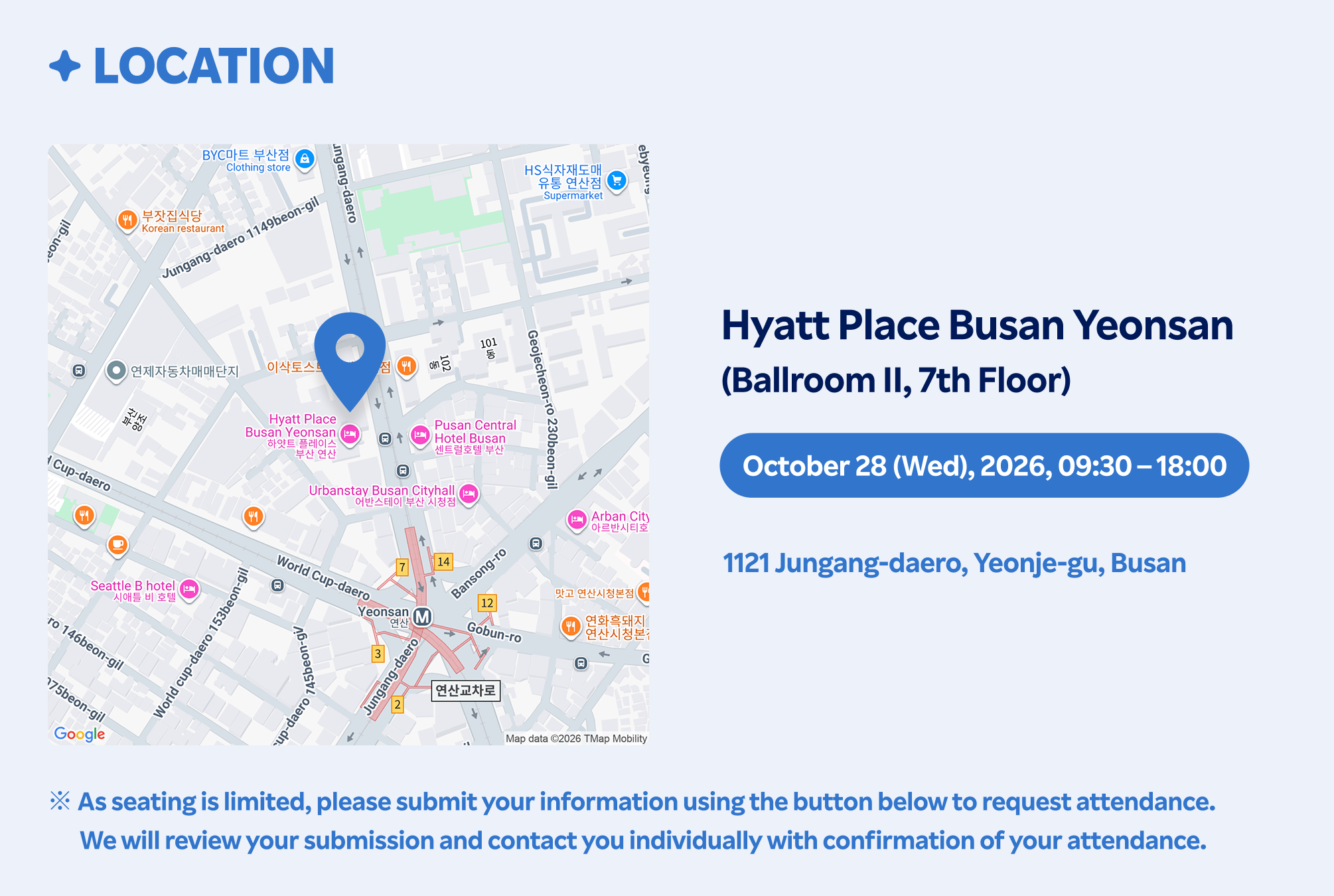
●Address: Hyatt Place Busan Yeonsan, Ballroom II (7F), 1121 Jungang-daero, Yeonje-gu, Busan — a short walk from Yeonsan Station (Busan Metro Lines 1 & 3)
●Inquiry: is-rs_maritime@rakuten.com
📄 View the official summit overview & speaker line-up (image)
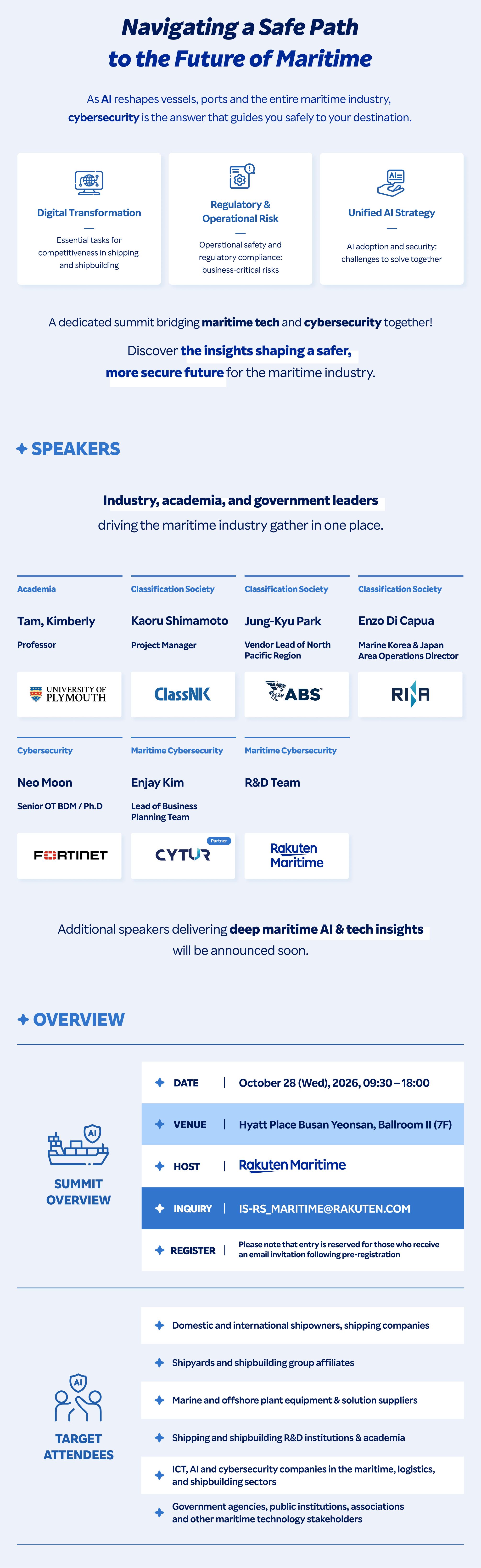
Image: Rakuten Maritime
⚓ Advisor's Closing Note
In every smart-ship and digital-twin project I have worked on, the lesson is the same: a model is only as trustworthy as the data and the network behind it. AI on board deserves that discipline — useful, powerful, and never trusted blindly. What makes MATS2026 worth the trip is that it puts the people who build the AI, the people who secure it and the people who certify it in the same room for a full day. I'll be there with my questions. I hope to see you in Ballroom II.
Register for MATS2026 →
Related Reading on ShipPaulJobs
Prepare for the summit with these posts, matched to the sessions above.
#MATS2026
#MaritimeAI
#MaritimeCybersecurity
#IACS_UR_E26
#IACS_UR_E27
#Busan
Disclosure: this is an event preview that links to the organiser's registration page. Event details, programme and images are from Rakuten Maritime's official MATS2026 page and are subject to change. The opinions and session commentary are my own (Iaan, Technical Advisor to ShipPaulJobs).


Comments
Post a Comment