Korea's Big Three Shipbuilders Are Racing to Build Data Centers That Float
Floating Data Centers (FDC) · Offshore AI Infrastructure · July 2026

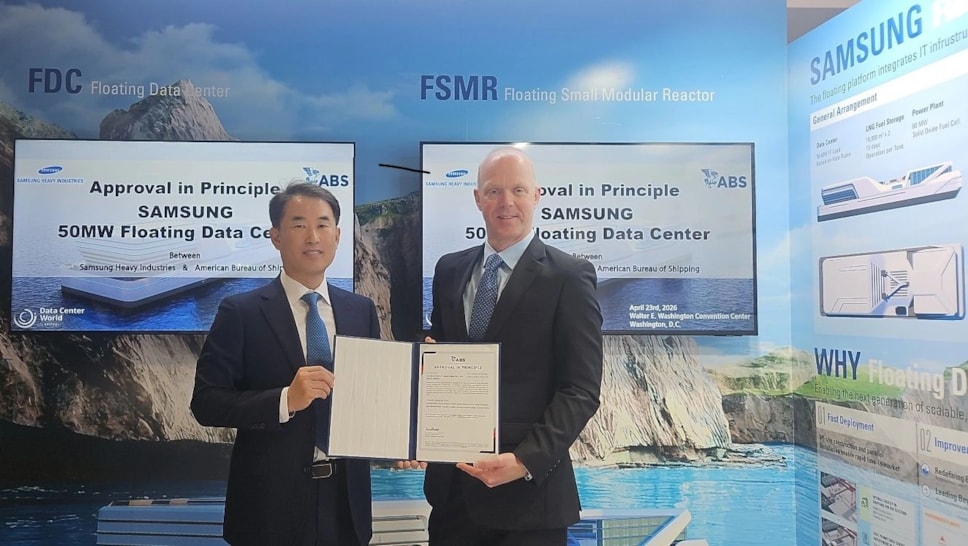
AI's hunger for computing power has become a hunger for electricity, land, and cooling water — resources that are running short around major data center hubs onshore. South Korea's biggest shipbuilders think they have an answer floating just offshore. In April 2026, Samsung Heavy Industries secured Approval in Principle from both the American Bureau of Shipping and Lloyd's Register for a 50-megawatt, LNG-powered Floating Data Center design. On July 7, 2026, HD Hyundai's shipbuilding arm signed its own partnership to enter the same market.
Neither company is inventing new hull technology to do this. Both are repurposing decades of offshore platform engineering — the same skill set used to build FPSOs and FLNG carriers — for a customer they have never really built for before: hyperscale cloud and AI companies.
This site's focus is what happens after the steel is cut. A data center that floats, is remotely managed, and hosts someone else's AI workloads is not just a vessel. It is critical infrastructure with a hull number — and that changes the cybersecurity conversation entirely.
Ⅰ. Latest News — Who Is Doing What
Three of Korea's largest shipbuilders are now positioning themselves in the floating data center (FDC) market, each at a different stage:
In April 2026, at the "2026 Data Center World" conference in Washington, D.C., Samsung Heavy secured Approval in Principle (AIP) from both ABS and Lloyd's Register for a 50-megawatt, barge-type FDC design that generates its own electricity from LNG. The company then signed a joint development agreement with U.S. AI server maker Supermicro and is now validating AI server operations in a marine environment, targeting commercialization in Q2 2028.
On July 7, 2026, HD Korea Shipbuilding & Offshore Engineering (HD KSOE) signed a memorandum of understanding with French power infrastructure company Schneider Electric to jointly develop offshore power and cooling infrastructure for FDCs. HD Hyundai is described in industry coverage as being in the early stages of this business compared to Samsung Heavy.
Hanwha Ocean has not yet announced a concrete FDC program but is reported to be reviewing entry into the market, watching how Samsung Heavy's and HD Hyundai's early moves play out.
Industry coverage from KED Global and the Korea JoongAng Daily notes growing FDC order interest specifically from North American clients — a signal that this is being driven by real demand, not just shipyard marketing.
Ⅱ. Technology Behind the News — Why a Data Center Needs a Hull
A Floating Data Center is exactly what it sounds like: rows of AI server racks and GPU clusters, built into a barge or vessel hull instead of a land-based warehouse. It sounds novel, but the engineering underneath it is not — it is the same discipline used to build FPSO (Floating Production Storage and Offloading — a vessel that produces, stores, and offloads crude oil at sea) and FLNG (Floating Liquefied Natural Gas — a vessel that liquefies and stores natural gas at sea) units, which have put heavy industrial process equipment safely on the water for over 20 years.
AI servers generate enormous heat. On land, that heat is removed using energy-intensive air conditioning or scarce fresh water. At sea, the ocean itself is an almost unlimited, free cooling source — the same principle ships have used to cool engines for a century.
Land-based data centers often wait years in a queue to connect to the electrical grid. Samsung Heavy's design sidesteps that entirely by generating its own power on board using LNG — the FDC brings its own power plant with it.
For scale: a large hyperscale land data center campus can run into the hundreds of megawatts. A single 50MW FDC unit is a meaningful building block — not a full replacement — meaning the real business model is likely fleets of these units, not one-off vessels.
AIP (Approval in Principle) is a classification society's early-stage confirmation that a concept design is technically sound enough to proceed toward detailed engineering. It is a green light to keep developing — not a finished, certified, sail-ready vessel.
Ⅲ. Why It Matters — A New Customer for Shipbuilders
Land-based data center construction is running into three walls at once: power grid connection queues that can take years, land scarcity near major population and network hubs, and cooling water rights that are increasingly contested in drought-prone regions. A conventional 100-megawatt land-based data center costs an estimated $800 million to $1.2 billion before land and GPUs are even counted. FDCs cannot dodge every one of those costs, but they can sidestep the grid queue and the land constraint entirely — and shipbuilders can command higher margins by supplying the specialized seawater cooling and safety systems these units require.
If this market matures as its backers expect, it would mark one of the most significant shifts in shipbuilding demand in a generation — not driven by trade volumes or fleet renewal cycles, but by the world's AI compute shortage.
Ⅳ. Cybersecurity Perspective — Critical Infrastructure With a Hull Number
This is the part the shipbuilding press releases skip entirely, and it is exactly the gap this site exists to cover. A Floating Data Center is not a ship that happens to carry servers. It is critical infrastructure that happens to float. Its attack surface spans two worlds that have historically been secured by completely different teams, under completely different rules:
Navy-tagged items are the "IT" side (someone else's AI compute). Red-tagged items are the "OT" side (the systems that keep the vessel itself alive). Teal-tagged items connect the FDC back to shore. Today, most FDC concept designs do not clearly separate these three worlds.
Because ABS and Lloyd's Register are treating FDCs as classed vessels or floating units, I expect IACS UR E26 and E27 — the cyber-resilience unified requirements already applied to newbuild computer-based systems from July 1, 2024 — to extend to FDC newbuilds as well, covering integrated automation, cooling, and power management systems. The tenant's GPU workloads sit outside class scope, but the vessel's own OT does not.
A properly designed FDC should treat tenant AI compute and vessel OT (propulsion, mooring, ballast, fire suppression, power management) as if they belong to two entirely separate ships sharing one hull — segmented under IEC 62443 zone-and-conduit principles, with Zero Trust — the security principle of never automatically trusting a device or user, even inside the internal network, and verifying every access request — governing remote management access, and mapped against the NIST Cybersecurity Framework's Identify–Protect–Detect–Respond–Recover functions end to end.
Ⅴ. My Perspective — Is This Actually Feasible?
My honest assessment: the hull is the easy part. Korean shipyards have spent over 20 years building FPSOs and FLNG units — floating a heavy industrial process plant on water is not a new engineering problem for them. The steel, the mooring, the marine systems integration — that part of this story is genuinely low-risk.
The real bottleneck is not steel. It is standards that do not exist yet — no IACS unified requirement written specifically for FDCs, no established reliability data on how vibration, salt exposure, and humidity affect GPU clusters over years at sea, and no settled framework for securing a facility that is simultaneously a classed vessel and a hyperscale data center.
Samsung Heavy's Q2 2028 target for a single 50MW unit is realistic. AIP is already secured, a server-hardware partner (Supermicro) is in place, and the engineering risk is manageable. This is the demonstration phase.
Reliability data from pilot units feeds into classification society rules and, likely, an extension of IACS-style cyber resilience requirements to FDCs specifically. This phase determines who is allowed to scale and who is not.
Multi-hundred-megawatt fleets of FDCs that hyperscalers actually plan capacity around. I would treat this as the realistic window for genuine commercial scale — not 2028, which is a single-unit milestone, not a market.
The ocean solves the shipbuilders' power and cooling problem.
It does not solve the security problem.
That part still has to be engineered — before the first hyperscaler signs a contract, not after.
Floating Data Centers are a genuinely smart engineering answer to a real land-based bottleneck — Korea's shipbuilders are not chasing a fad, they are applying 20 years of offshore expertise to a new customer.
But a barge full of GPUs, remotely managed and connected to satellite links, is a national-security-adjacent asset the moment it leaves the yard — and the cybersecurity framework for that needs to exist before the fleet does, not after.
Related Articles & Sources
More From ShipPaulJobs
Director at a global Big 4 consulting firm specializing in Maritime Cyber Security, AI, and Data Analytics. 20+ years spanning shipbuilding R&D, AI product development, and maritime cyber compliance. Specializes in IACS UR E26/E27, IMO MSC guidelines, and smart ship development. Founder of ShipPaulJobs.
⚓ Join the ShipPaulJobs Community
Join →


Comments
Post a Comment